



When Archrival and Vogue Business came back for part two of their Gen Z report, a thought-leadership piece that marketers still quote, share, and argue about 18 months after launch, they needed more than another long article.
They wanted an interactive editorial experience that felt as scrollable and chaotic as Gen Z's feeds, but still as sharp and credible as a Vogue feature.
The first report challenged the classic marketing funnel and became a reference point across the fashion and marketing industry. Marketers still share it in Slack channels, present it internally, and use it to sell in new strategies.
For chapter two, the stakes were higher. It had to feel like a "second album" that lives up to the first, but doesn't repeat it. It needed a visual story that could handle fewer but deeper sections, with more copy and more nuance.
Noomo collaborated with Archrival and Vogue Business to design and build a WebGL-powered, story-driven page that visualizes how Gen Z shop in a world of "doom-shopping," infinite scroll, and over-engineered convenience.
The result is a new digital universe that lives comfortably between fashion editorial, experimental web design, and social-native content.
Why this report needed a new universe.
Part one of the Gen Z report became a cultural artifact in the marketing world — the kind of piece that gets referenced in presentations, saved in strategy folders, and shared in team channels months after launch.
For chapter two, we had to:
- Create a "second album" that lives up to the first without repeating it
- Handle denser research and more nuanced editorial content
- Feel more native to today's social and shopping behaviors
- Be less "pretty website," more "internet artifact" people want to react to and dissect
Here's the tension we were working with. Shopping has become so optimized, so convenient, so data-driven that it's lost its soul. Gen Z want friction back. They want meaning, magic, IRL experiences, curation, community.
The web experience needed to make that emotional shift tangible, not just readable.
Our answer was a universe built on contrast.
Calm vs chaos. Editorial vs glitch. Physical vs digital. Friction vs frictionless.
The layout, motion, and visuals literally walk the user from doom-scroll fatigue into a more intentional, magical way of shopping.
Understanding the brief: editorial sophistication meets Gen Z chaos.
The brief from Archrival was clear:
Build a visually rich, hyper-engaging report that mirrors the chaotic, fragmented energy of Gen Z internet culture.
Make dense research and editorial copy feel approachable, scannable, and actually fun to scroll through.
Design "screenshot-ready" moments, cards, and layouts that look great behind talking-head videos on TikTok, LinkedIn, and Reddit, and encourage organic sharing.
Honor Vogue Business' editorial sophistication while carving out rebellious pockets of Gen Z culture within the page.
For fashion houses, luxury brands, and media companies, this represents something new. How do you create editorial experiences that work as both authoritative research and shareable social content?
That was the challenge.
The discovery process: aligning three teams on one vision.
A two-hour remote workshop in Figma brought everyone together. Archrival, Vogue Business, and our team.
We mapped what worked in the first edition, what felt outdated, and where part two needed to evolve. From shorter content blocks to more 3D, spatial layouts and better social shareability.
Three big insights came out of that workshop.
What we discovered in the workshop:
The tension we needed to express
Gen Z's shopping experience is full of contradictions.
They doom-scroll through product feeds while craving meaningful discovery. They want convenience and friction. They're digital natives who yearn for physical retail magic.
We needed the design to hold that tension.
The audience shift
The first report spoke to marketing strategists. Part two needed to resonate with C-suite fashion executives, media leaders, brand directors. People making decisions about retail experiences, not just campaigns.
Different audience. Different depth.
The social reality
This report would live beyond Vogue's site.
Creators would screenshot it. LinkedIn strategists would quote it. Reddit threads would debate it.
Every layout decision had to work when cropped, covered by a talking head, or reposted out of context.
Here are some of the early mood boards we explored:
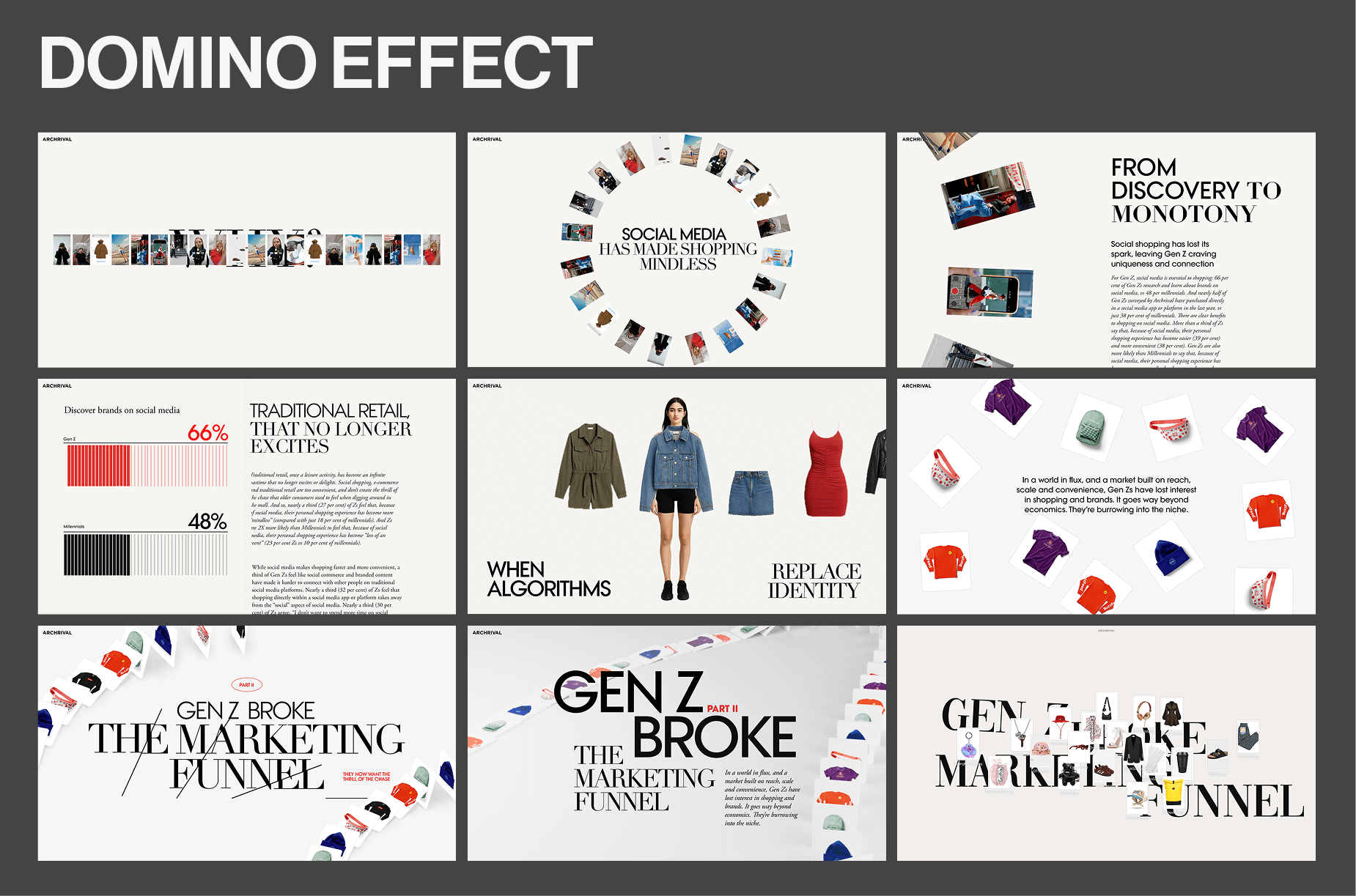 Domino Effect layout showcasing multiple editorial sections including product discovery visualization, traditional retail analysis, and Gen Z marketing funnel breakdown - Vogue Business interactive report design
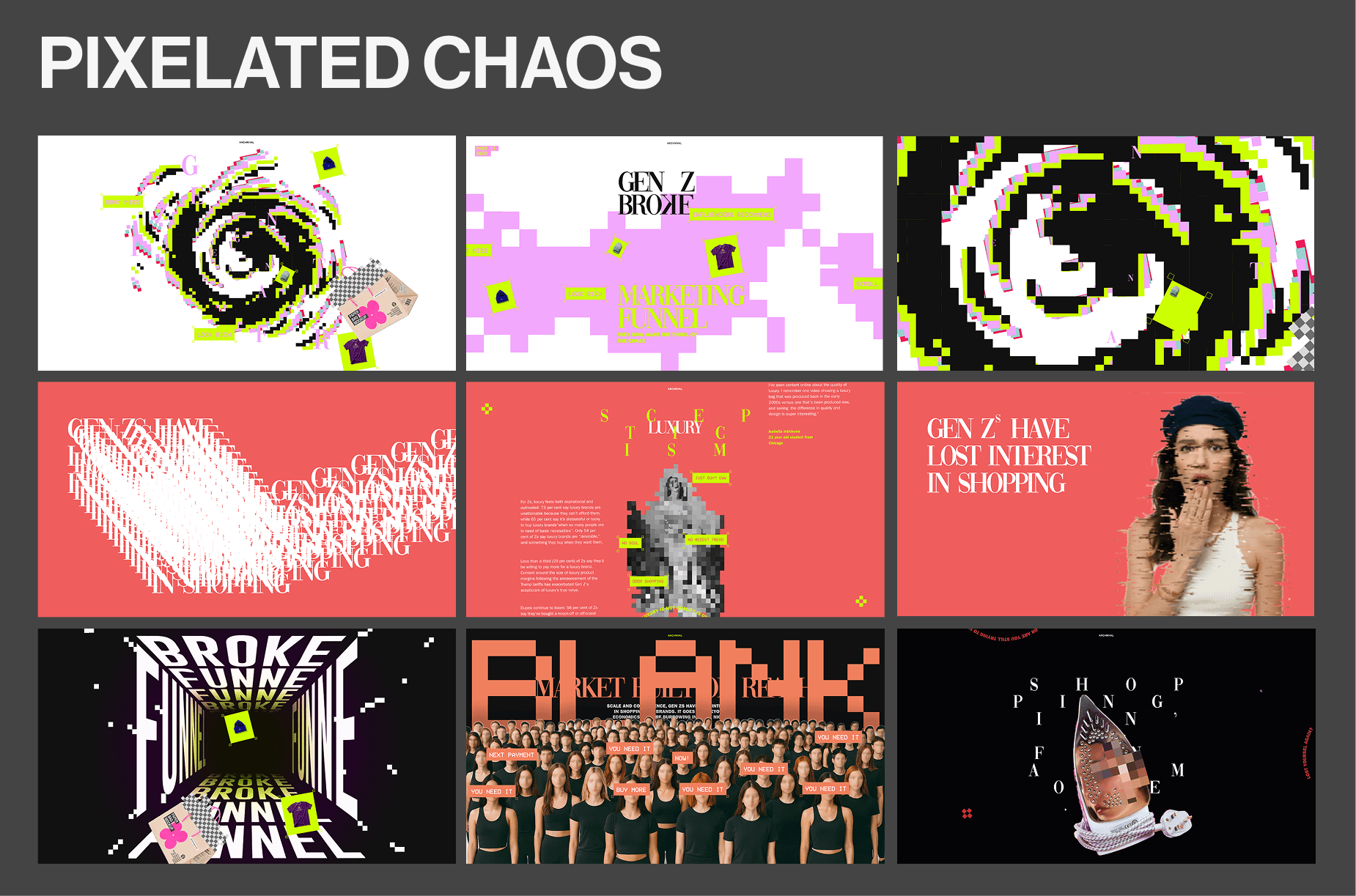 Pixelated chaos design treatment showing glitch effects, neon highlights, and distorted imagery illustrating Gen Z's fragmented shopping experience - interactive editorial design by Noomo for Vogue Business
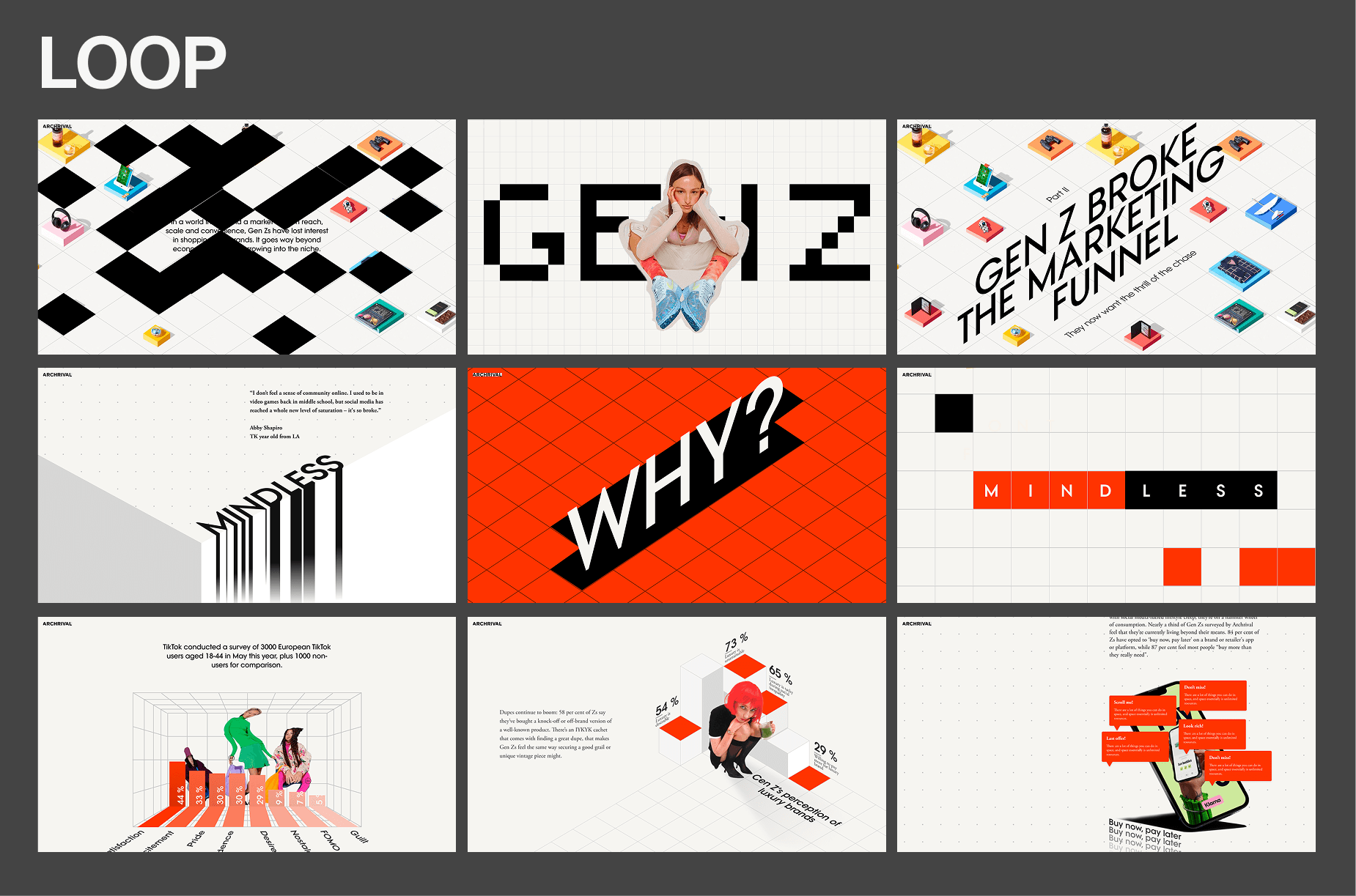 Loop concept visualization showing isometric shopping cycle, Gen Z typography, doom-scroll patterns, and data charts illustrating mindless shopping behaviors - interactive editorial web design for Vogue Business
Three design principles that emerged:
Editorial frame, chaotic windows
We used Vogue's black-and-white minimalism as a foundation. Clean, generous negative space acting as a "wall."
Within that wall, we opened windows into Gen Z's messy reality. Overflowing closets. Stacked boxes. Lo-fi social captures. Pixelated noise.
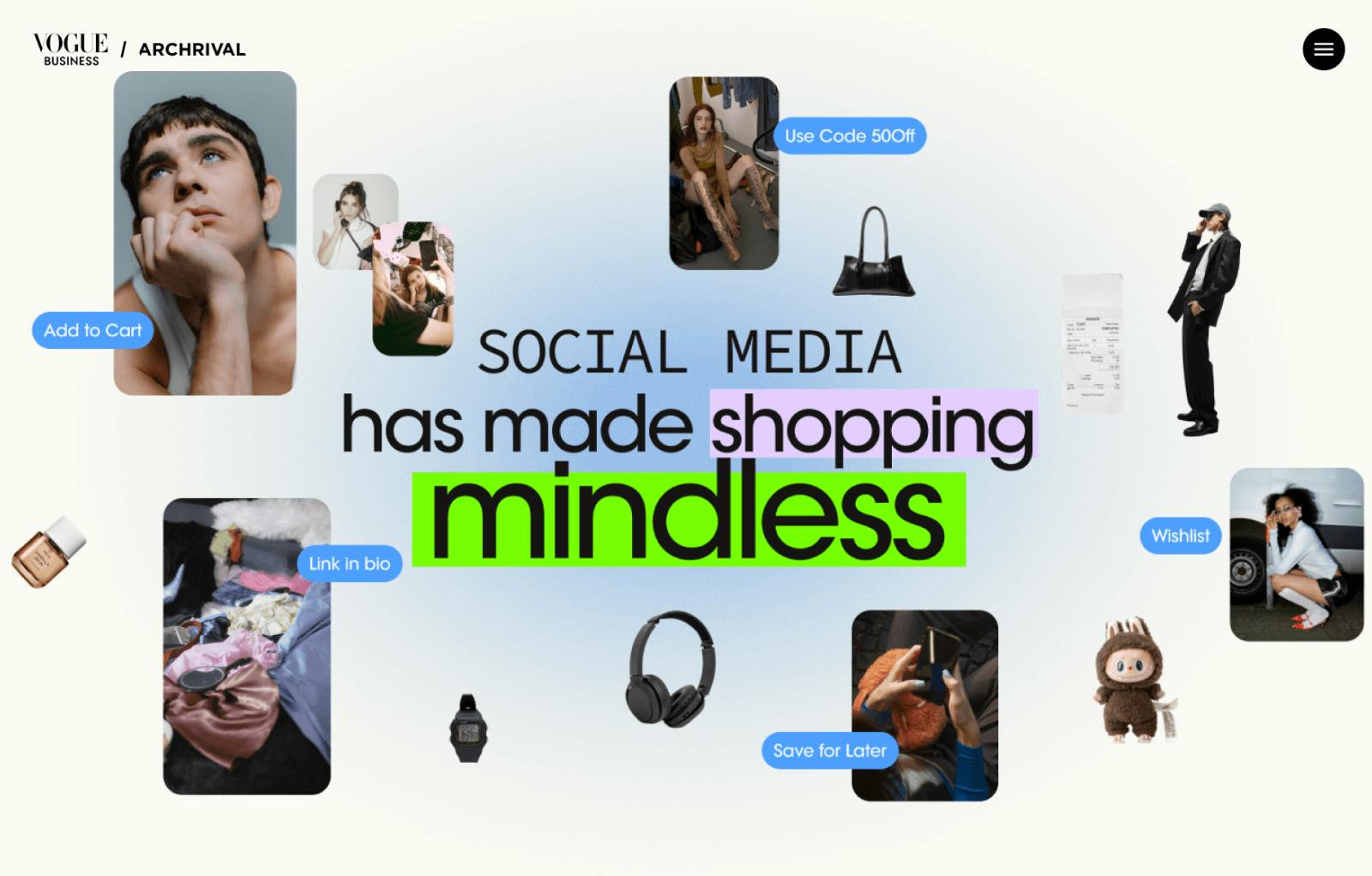 Vogue Business Gen Z Report interactive editorial design showing social media shopping chaos with product cards, UI elements, and headline 'Social media has made shopping mindless'
Contrast as a core design move
Quiet, almost gallery-like sections contrast with dense, object-filled scenes that evoke overconsumption and doom-shopping.
This rhythm keeps the experience readable while still dripping with attitude.
Playful typography with serious content
Body copy stays clean and accessible.
Headlines use deliberate font clashes. Classic serif for Vogue heritage. Modern sans for clarity. Expressive script and pixel fonts to inject raw internet energy.
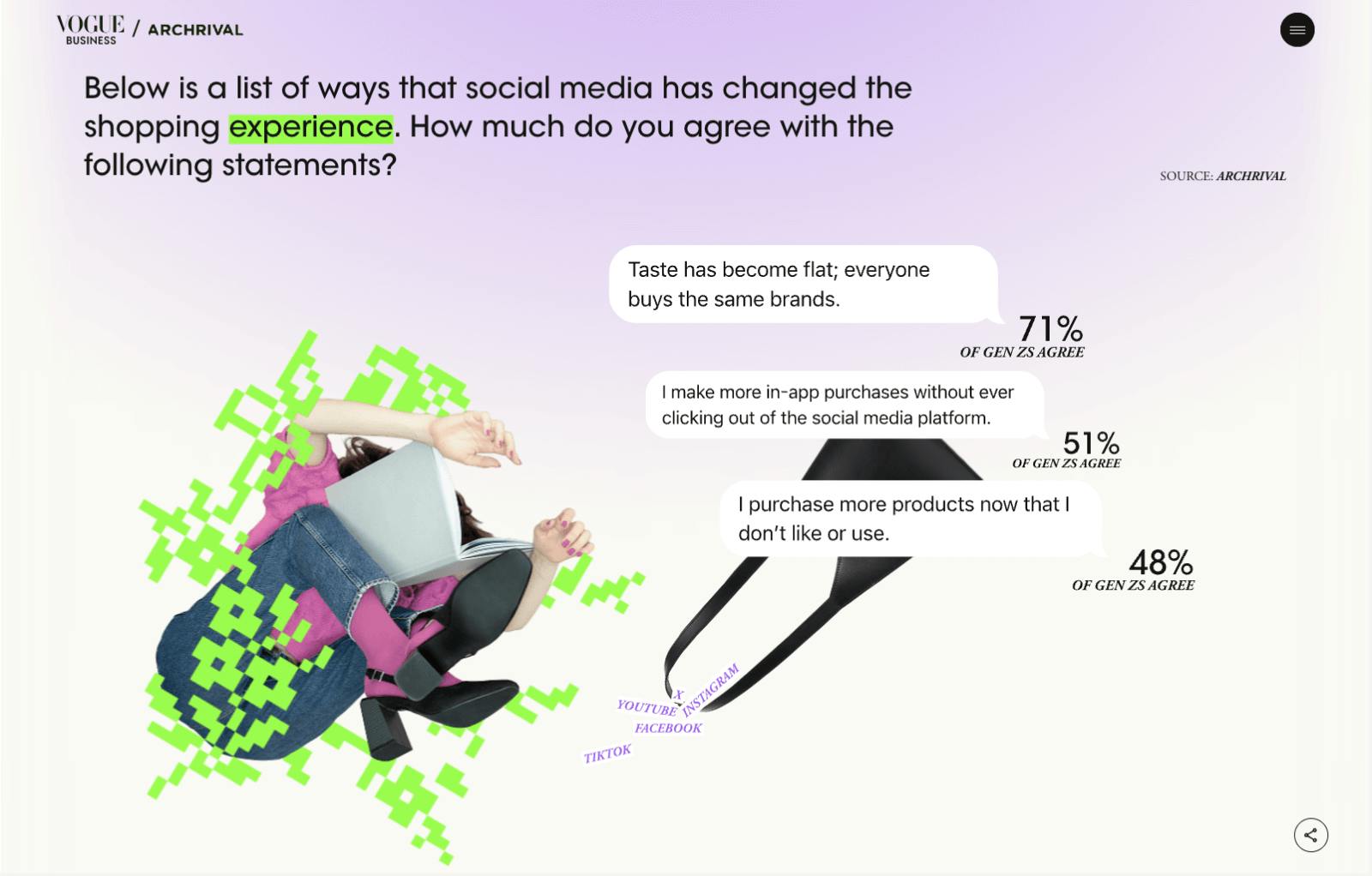 Gen Z shopping behavior data visualization showing 71% agree taste has become flat, 51% make in-app purchases, 48% purchase products they don't use - Vogue Business Archrival research
Designing for chaos and clarity: the visual system.
The visual language leans fully into contrast instead of perfection.
Font mashup: editorial meets internet
We deliberately mixed typefaces.
Refined serifs sit alongside Vogue sans serif. Ornamental scripts mix with pixel-driven UI elements.
This echoes how Gen Z actually dress. Archive fashion plus streetwear plus meme aesthetics in one look.
Each typeface carries meaning:
- Serif = Vogue heritage, editorial authority, timelessness
- Sans serif = Clarity, accessibility, modern luxury
- Script/pixel fonts = Gen Z energy, internet culture, irreverence
Nature vs glitch: hybrid imagery
8-bit illustrations of leaves and flowers appear next to realistic product photography.
This isn't random decoration. It mirrors how Gen Z lives—one foot in the physical world, one in the digital. Thrifting IRL while shopping via influencers and algorithms.
The natural elements represent what Gen Z is searching for. Organic discovery. Serendipity. Connection to physical objects and spaces. Magic.
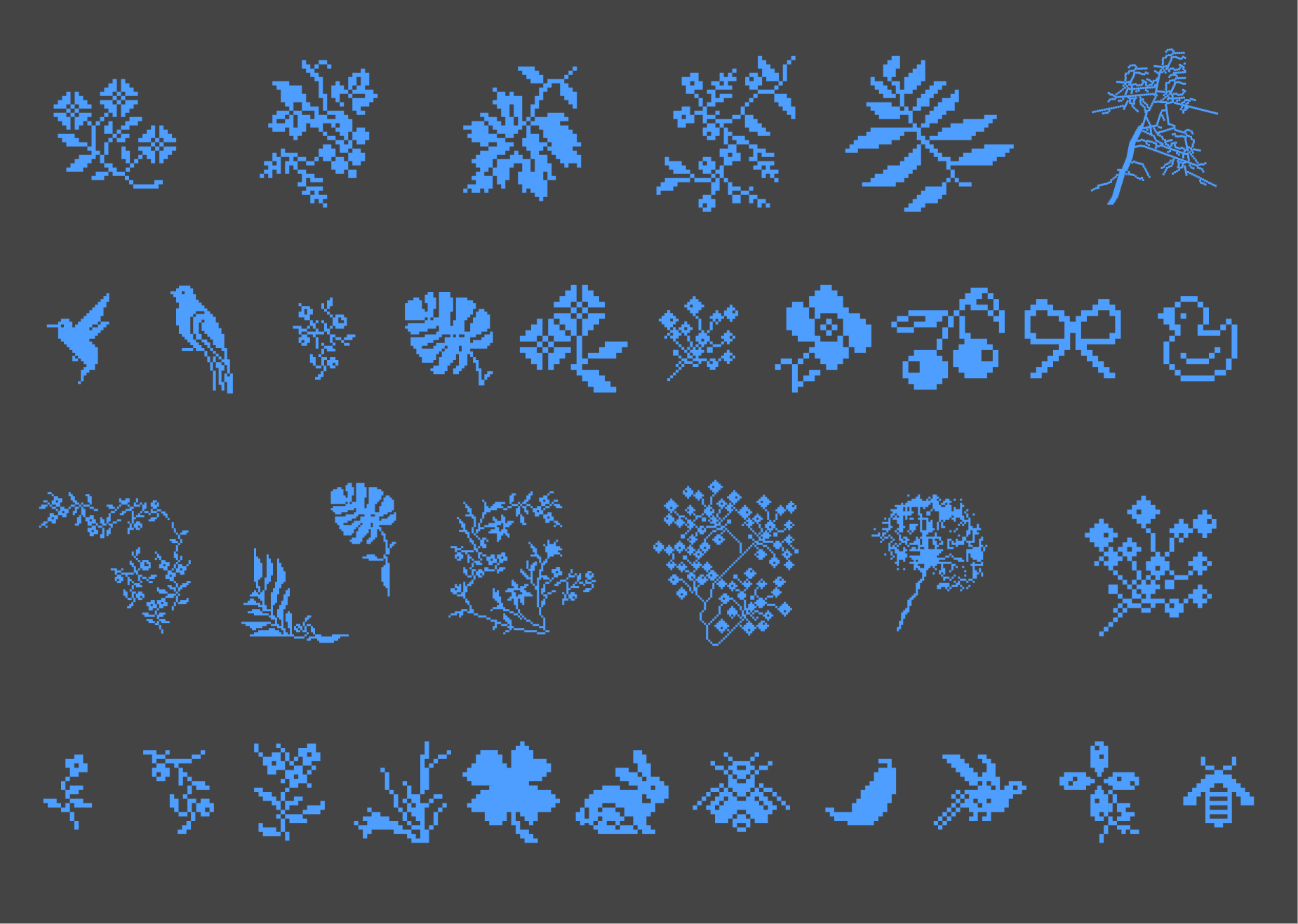 Collection of 8-bit pixelated nature icons including flowers, leaves, birds, and botanical elements in blue representing the search for magic and meaning in Gen Z shopping - Vogue Business Archrival report design
Lo-fi editorial photography
We balanced Vogue-level studio shots with raw, social-native imagery.
Unretouched faces. Cluttered closets. Packaging piles. Behind-the-scenes moments that break the glossy surface.
This mirrors Gen Z's media diet. They watch high-production Netflix. They also create raw, unfiltered content on TikTok and BeReal.
Both matter.
UI elements, not stickers
Instead of trendy "Gen Z stickers," we borrowed from real product interfaces.
Pills. Buttons. Tags. Cursors. Windows.
The interface feels like a live operating system of shopping rather than a poster designed "at" Gen Z from the outside.
Data visualization: making research shareable.
The report is heavy on stats, comparisons, and emotional insights: doom cycles, guilt, FOMO, and the hunt for meaning in shopping again. Simply embedding charts wasn't an option.
For fashion and media brands, this challenge is universal: how do you make research feel premium, authoritative, and shareable all at once?
Three principles guided us:
Legible first, delightful second
Each data visualization follows a consistent visual language. Consistent shapes, scales, labels.
Readers don't have to decode every graphic from scratch. This matters for executive audiences who need quick insights without sacrificing depth.
Scroll-triggered emphasis
Key comparisons (e.g., Millennials vs Gen Z, doom vs magic, mindless vs meaningful) animate into view as the user scrolls, drawing attention to the punchline of each stat without overwhelming the page.
The animation timing is carefully choreographed, not so fast that it feels frantic, not so slow that it breaks reading flow.
Cards designed for screenshots
Stats, quotes, and frameworks live in self-contained cards and layouts that still look strong when cropped or partially covered by a creator's talking head on TikTok, or when reposted on LinkedIn and Reddit.
Each card is designed to:
- Work as a standalone visual
- Maintain Vogue's brand identity even when cropped
- Include enough context to be understood out of context
- Look premium in any social feed or presentation deck
The result: data that reads like a "secret playbook" marketers can quickly share with their teams, not just a wall of numbers.
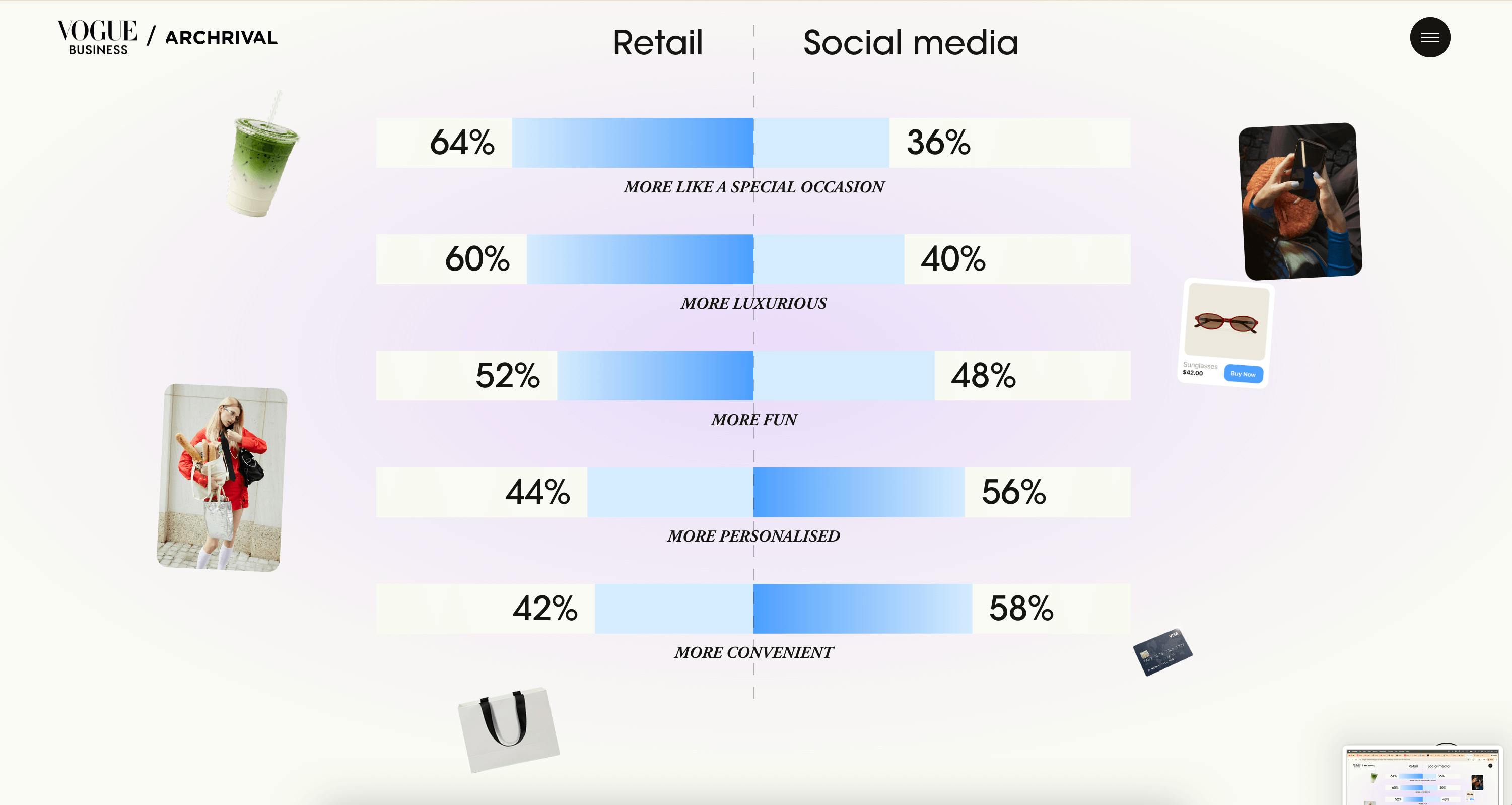 Retail versus social media shopping behavior comparison chart showing Gen Z preferences - 64% discover brands on social media, 60% want AI avatars, 52% prefer affiliate marketing - Vogue Business interactive data visualization
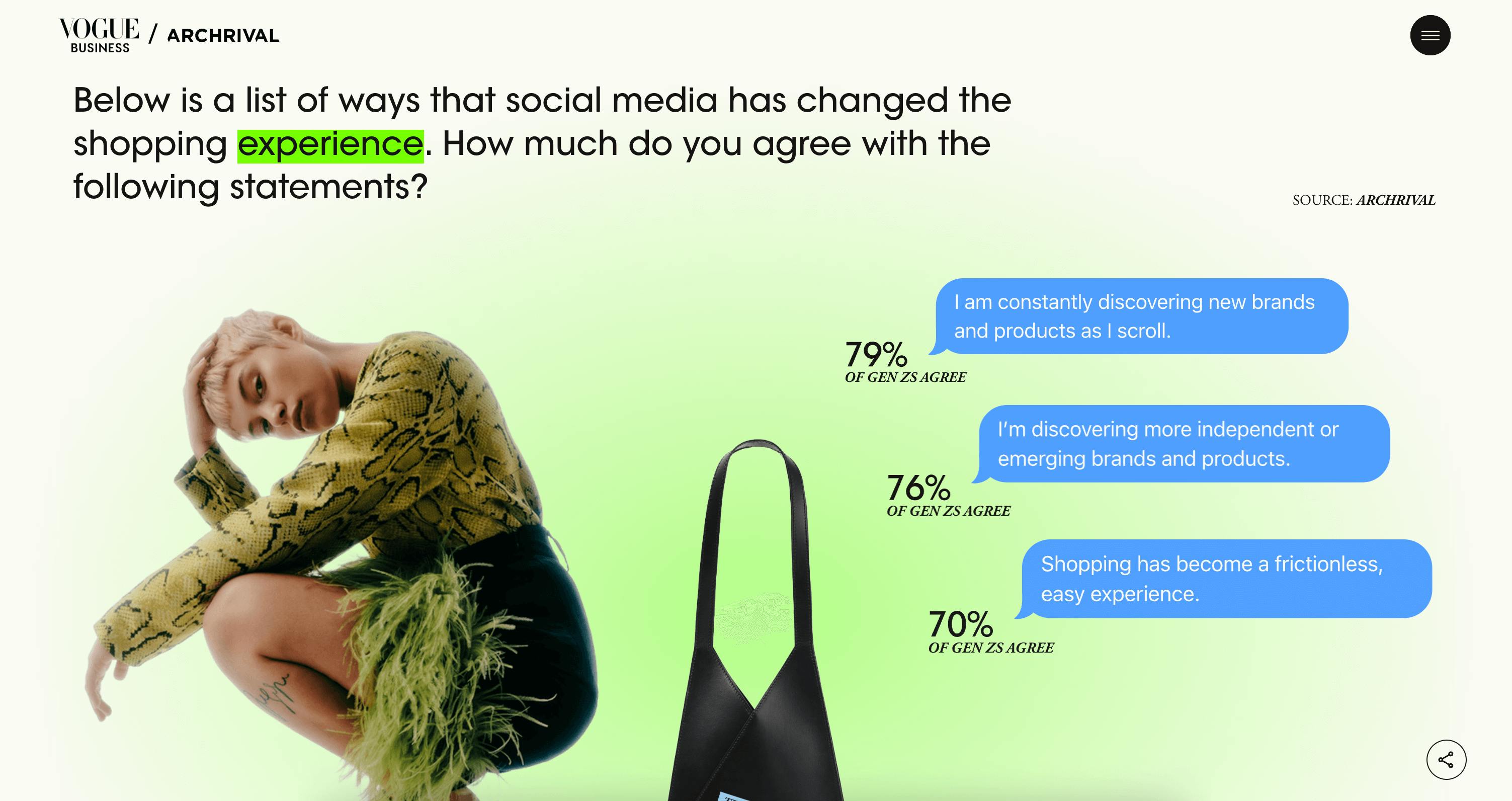 Interactive survey question with product imagery showing how social media changed shopping experience - featuring handbag, stuffed animal toy, and chat bubble UI elements with percentage responses - Vogue Business editorial design
Motion and interaction: making emotion feel tactile.
From the start, the goal wasn't just to illustrate friction, overwhelm, or magic. It was to make users feel these states through motion.
This is where interactive web design moves beyond decoration into storytelling.
From doom-scroll to discovery
Early sections lean into linear, almost exhausting scroll. Echoing "shopping in a cycle of doom, guilt, and FOMO."
They gradually open up into more spacious, exploratory layouts. Layouts that reward intentional clicks and drags.
The pacing shift is deliberate. Readers experience the exhaustion of endless feeds before arriving at moments of calm, clarity, and intentional discovery.
It's storytelling through rhythm.
Tactile interactions
Imagery, glitch overlays, and cards respond to hover, drag, and scroll with physicality.
Stretching. Shaking. Revealing. Snapping into place.
Users feel like they're manipulating real objects, not just pixels.
This references the IRL shopping experiences Gen Z craves. Touching fabrics. Discovering hidden vintage pieces. Feeling the weight of quality products.
Micro-chaos, macro-control
Micro-animations inject surprise. Flickering glitches. Looping GIFs. Directional parallax.
But the overall scroll stays smooth and controlled. Long-form reading never feels like a chore.
The balance matters. Too much chaos exhausts users. Too much control feels corporate and lifeless.
Social-native behaviors
Certain sections use familiar interfaces. Pinterest-style grids. Swipeable carousels. Stacked tweet or TikTok cards.
We're not copying social platforms. We're acknowledging that Gen Z's muscle memory is shaped by these interfaces.
That familiarity makes complex research feel approachable.
Technical execution.
Under the hood, careful performance work keeps all of this fluid on a long, interaction-heavy page.
Performance optimization strategies:
Asset optimization
- Compressed images and videos without visible quality loss
- WebP format for all photography
- Strategic use of blur-up placeholders
- SVG for all iconography.
Lazy loading
- Content loads progressively as users scroll
- Heavy animations don't initialize until in viewport
- 3D elements render only when needed
GSAP timeline optimization
Tight animation timelines that don't overlap unnecessarily
- Smooth scrolling with minimal repaints
- Hardware-accelerated transforms
The result: the experience feels seamless rather than heavy, even on mid-tier devices and slower connections.
For fashion brands considering interactive editorial projects, this technical foundation is non-negotiable — beautiful design means nothing if the experience lags or crashes.
Collaboration: working as one creative team.
The experience grew directly out of shared thinking with Archrival and Vogue Business.
How we structured the collaboration:
Initial alignment session
A regroup at the start aligned on editorial direction, what needed to evolve from part one, and where custom interactions would provide the most value within scope and budget.
Design workshop
Both teams mapped the content into narrative "chapters," identified emotional beats (doom, guilt, FOMO, magic, meaning), and prioritized the highest-impact visuals and transitions.
Translation to production
Noomo then translated this alignment into detailed UX flows, art direction, motion prototypes, and ultimately a production-ready WebGL build.
For media companies and fashion brands this collaborative approach ensures the final experience authentically represents both the brand's editorial voice and the technical possibilities of modern web design.
Early impact and industry response
It's still early after launch, so the long-term metrics are just starting to come in. But the project has already achieved several key outcomes:
A distinct Gen Z visual universe that feels fresh compared to the previous report, while still recognizably Vogue Business.
A research hub built for sharing: from TikTok reactions with the site behind creators' heads, to Slack screenshots and design blog features.
Strengthened industry positioning for both Archrival (as the go-to youth culture partner) and Vogue Business (as a forward-thinking editorial brand that understands interactive storytelling).
New inbound conversations from fashion houses, beauty brands, and lifestyle companies curious about creating similar research-driven editorial experiences.
The hope is the same as with part one: that this experience keeps circulating long after launch—sparking debate, inspiring brand teams, and demonstrating what's possible when editorial rigor meets experimental web design.
What media and fashion brands can learn.
Interactive editorial is the new white paper
Traditional research reports sit as PDFs in download folders. Interactive experiences live as bookmarks, shared links, and social content that keeps generating value months after launch.
Design for shareability from day one
Every section, card, and data visualization should work when:
- Cropped in a screenshot
- Covered by a talking head in a TikTok video
- Reposted to LinkedIn with commentary
- Dropped into a presentation deck
Embrace contrast over perfection
The most memorable editorial experiences don't try to be flawless — they embrace tension, contradiction, and the messy reality of how audiences actually experience brands.
Make emotion tactile through interaction
Motion and interaction aren't decoration, they're storytelling tools that can make abstract concepts (doom-scrolling, FOMO, discovery) feel physically real.
Collaborate as creative equals
The best work emerges when client teams and design teams shape the vision together from the start, rather than working in sequence.
Creating editorial experiences.
This project represents a new model for how fashion houses, magazines, and lifestyle brands can create thought leadership that's both authoritative and genuinely engaging.
Whether you're launching a research report, building a brand manifesto, or creating an editorial experience around a collection or campaign, the principles remain the same:
- Start with emotional truth, not just information
- Design for how content will actually be consumed and shared
- Use motion and interaction to make concepts tangible
- Balance editorial sophistication with internet-native energy
- Build experiences that reward both quick scans and deep dives
At Noomo, we specialize in translating complex brand stories into immersive digital experiences—for companies who need to balance editorial authority with experimental design.
Technologies and tools.
Design:
- Figma for collaborative workshops and design system
- Adobe Creative Cloud for asset creation
- Krea AI and Midjourney for visual exploration
Front-end development:
- WebGL for performant visual effects
- GSAP for animation timelines
- Custom JavaScript for scroll and interaction systems
- Responsive layout system optimized for mobile
Performance:
- Asset optimization and compression
- Lazy loading strategies
- Progressive enhancement
- Hardware-accelerated animations
Written by the Noomo team
Design and creative technology studio specializing in interactive editorial experiences, 3D web design, and immersive brand storytelling for tech, product, and media brands including Vogue Business, Salesforce, Red Bull, AMD, and Coinbase.
Frequently Asked Questions
What is an interactive editorial website?
An interactive editorial website turns a long-form report or article into a designed, scrollable experience where motion, data visualization, and layout carry the story alongside the text. For the Vogue Business Gen Z Report, Noomo built a WebGL-powered page where the design itself walks readers from doom-scroll chaos into intentional discovery making the research something people react to, screenshot, and share, not just read.
Why should brands turn research reports into interactive experiences?
Because PDFs get downloaded and forgotten, while interactive reports keep circulating. An interactive editorial lives as bookmarks, shared links, TikTok reactions, and LinkedIn screenshots for months after launch. Analytics confirmed that the first Vogue Business Gen Z report was still being quoted 18 months later. For fashion, media, and B2B brands, this format turns thought leadership into a lasting asset that generates inbound conversations rather than a one-time publication.
How do you make a research report shareable on social media?
Design every stat, quote, and framework as a self-contained card that survives being cropped, covered by a creator's talking head, or reposted out of context. Each card should work as a standalone visual, keep the brand identity when cropped, and carry enough context to be understood on its own. On the Vogue Business Gen Z Report, this "screenshot-ready" principle shaped every layout decision from day one.
What technology powers an interactive editorial website?
The Vogue Business Gen Z Report runs on WebGL for visual effects, GSAP for animation timelines, and custom JavaScript for scroll and interaction systems, with a responsive layout optimized for mobile. Performance work, including compressed WebP imagery, lazy loading, hardware-accelerated transforms, keeps the long, interaction-heavy page fluid on mid-tier devices. Beautiful editorial design means nothing if the experience lags, so the technical foundation is non-negotiable.
Related projects and insights
- Vogue Business Gen Z Report – View the complete case study
- Digital storytelling in web design – Our approach to narrative-driven experiences
- Best storytelling websites – Examples and principles for editorial web design
- 3D and immersive web experiences – Technical capabilities for premium brands
- Interactive brand activations – Conference and event experiences
Interested in creating an interactive editorial experience for your brand? Connect with us to discuss how we can help tell your story through design, motion, and technology.
FAQ