



Designing immersive event experiences for enterprise brands requires more than advanced visuals. It demands narrative clarity, technical precision, and the ability to translate complex systems into intuitive, emotionally engaging journeys. This article explores how immersive event experience design works at the enterprise level using AMD’s AI Factory as a real-world reference point rather than a traditional case study.
In short: immersive event experience design for enterprise brands requires systems thinking, narrative clarity, real-time 3D performance, and long-term scalability.
Immersive experiences are built across systems, not surfaces
Enterprise immersive event experiences succeed when creativity spans physical environments, digital storytelling, and interaction design working as one system.
For enterprise and hardware-driven brands, immersive events must balance two challenges at once: communicating deep technical complexity while remaining clear, engaging, and emotionally resonant.
This requires creativity across every layer from spatial design and narrative structure to real-time visuals, interaction logic, and performance optimization. Every decision contributes to how the experience is perceived and remembered.
From infrastructure to narrative: rethinking the “factory” metaphor
The ambition behind AMD’s AI Factory experience was never to replicate a literal data center. Instead, the goal was to reimagine what such an environment could represent.
Rather than framing the factory as a mechanical or industrial space, we explored how it could feel alive, a network driven by purpose, intelligence, and connection. Inspiration came not from traditional tech visuals, but from nature, biology, and ecosystems where multiple components work together seamlessly.
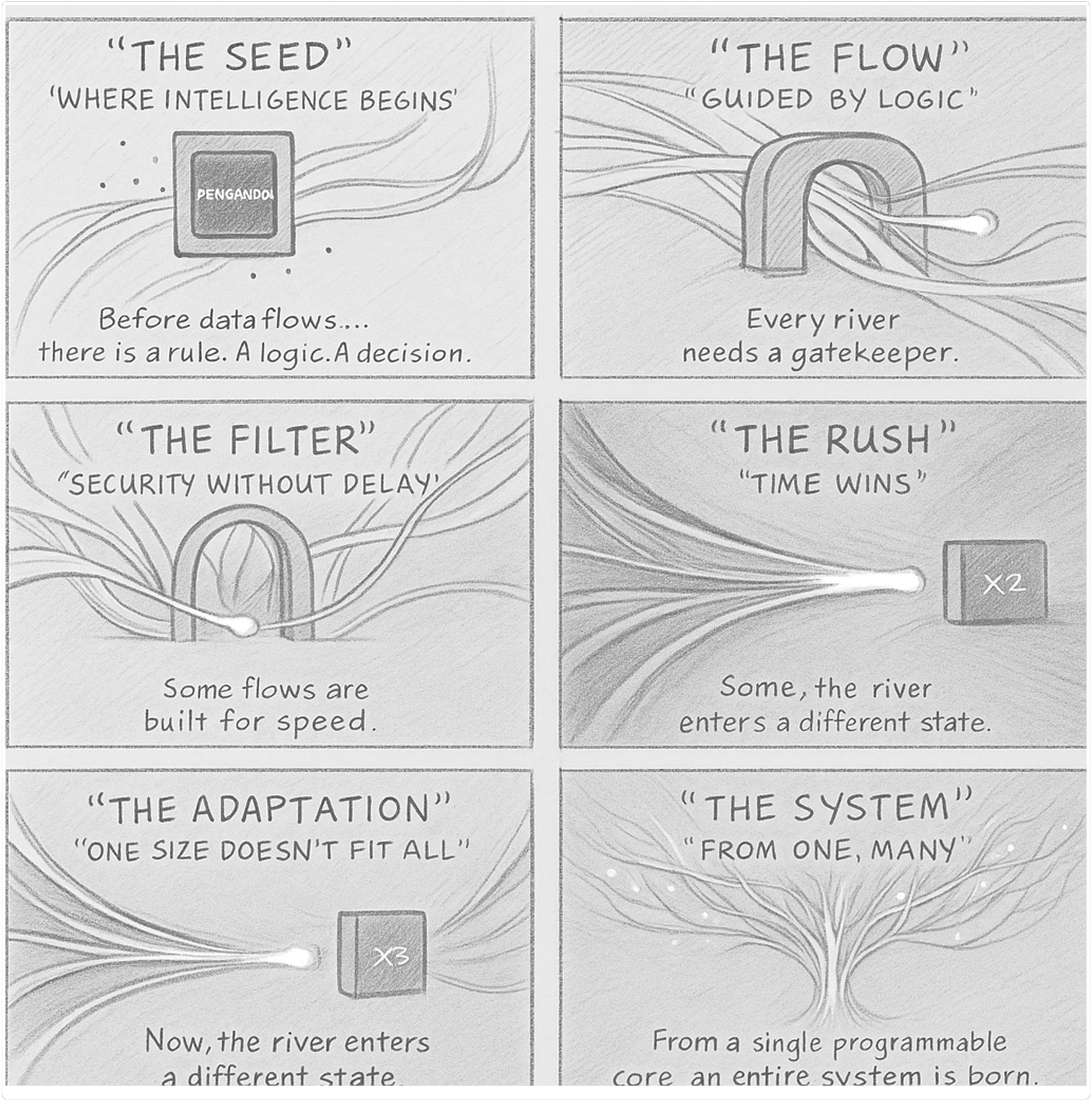 AMD AI Factory ideation workshop exploring narrative metaphors from nature, biology, and ecosystems instead of literal data center representation
This reframing allowed the experience to move beyond hardware and into storytelling — positioning AMD’s technology as part of a larger, intelligent system rather than isolated components.
Following our initial workshop, we defined a clear direction for the experience:
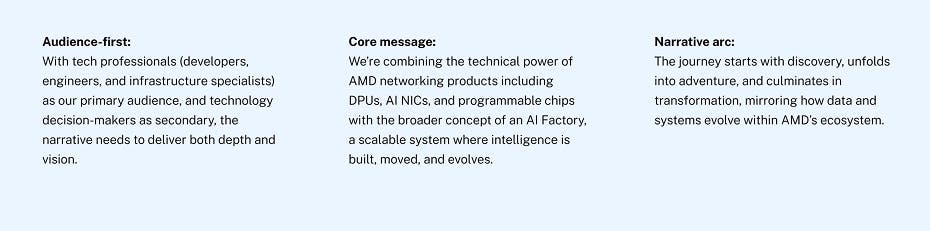 AMD AI Factory workshop insights documenting narrative direction defining intelligence, complexity revelation, and system component relationships
Defining the narrative system before the visual language
Before any visual style, motion tests, or 3D production, the focus was on defining the narrative system behind the experience. For enterprise brands, storytelling cannot rely on surface metaphors alone, it needs an internal logic that can scale across products, touchpoints, and future iterations.
In this case, the key question was not how the experience should look, but how it should behave.
What does intelligence feel like?
How does complexity reveal itself without overwhelming the audience?
How do individual components relate to one another within a larger system?
Answering these questions early allowed the narrative to function as a framework rather than a theme.
 AMD AI Factory first-iteration user flow diagram showing spatial navigation, progression logic, and interaction points for ecosystem experience
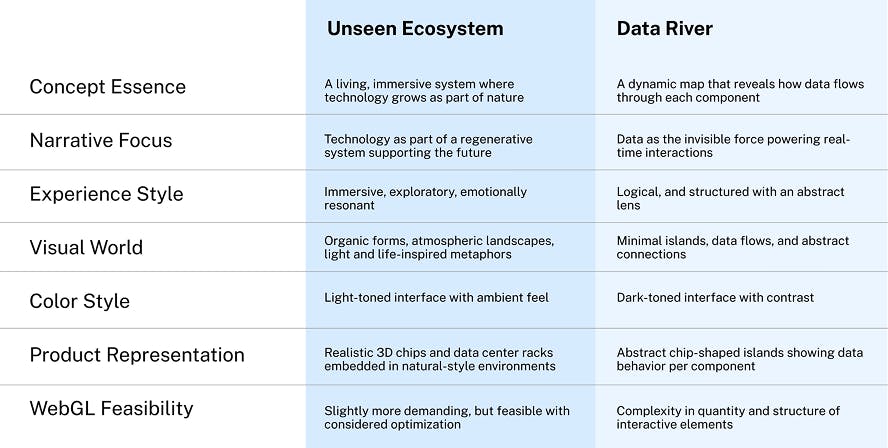
Early concept exploration: Data river vs. Ecosystem
At the exploration stage, multiple conceptual directions were developed in parallel to test how AMD’s technology could be translated into an experiential language.
The data river
The data river concept visualized information as a continuous, directional flow consisting of moving, splitting, converging, and accelerating through the system. It emphasized performance, throughput, and transformation.
This approach was particularly useful for exploring motion principles, rhythm, and pacing, as well as how users might visually follow data through a complex infrastructure. It helped shape early ideas around animation behavior and scale.
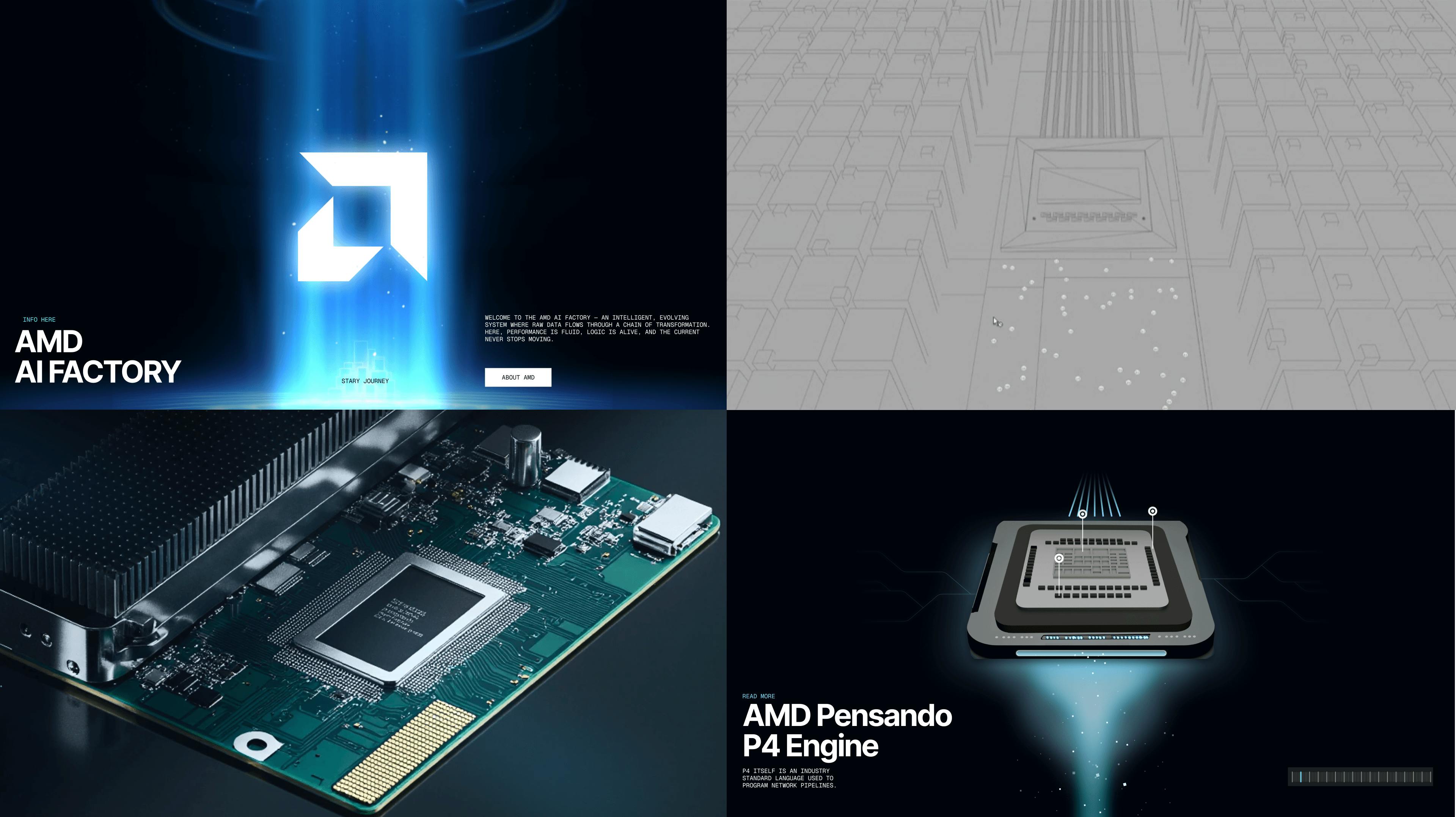 AMD AI Factory "Data River" concept visualization showing continuous directional flow, splitting, converging, and acceleration through system infrastructure
The ecosystem
In parallel, the ecosystem concept framed AMD’s technologies as interconnected components within a living, intelligent system. Rather than focusing on linear movement, this direction emphasized relationships, balance, and collaboration between elements.
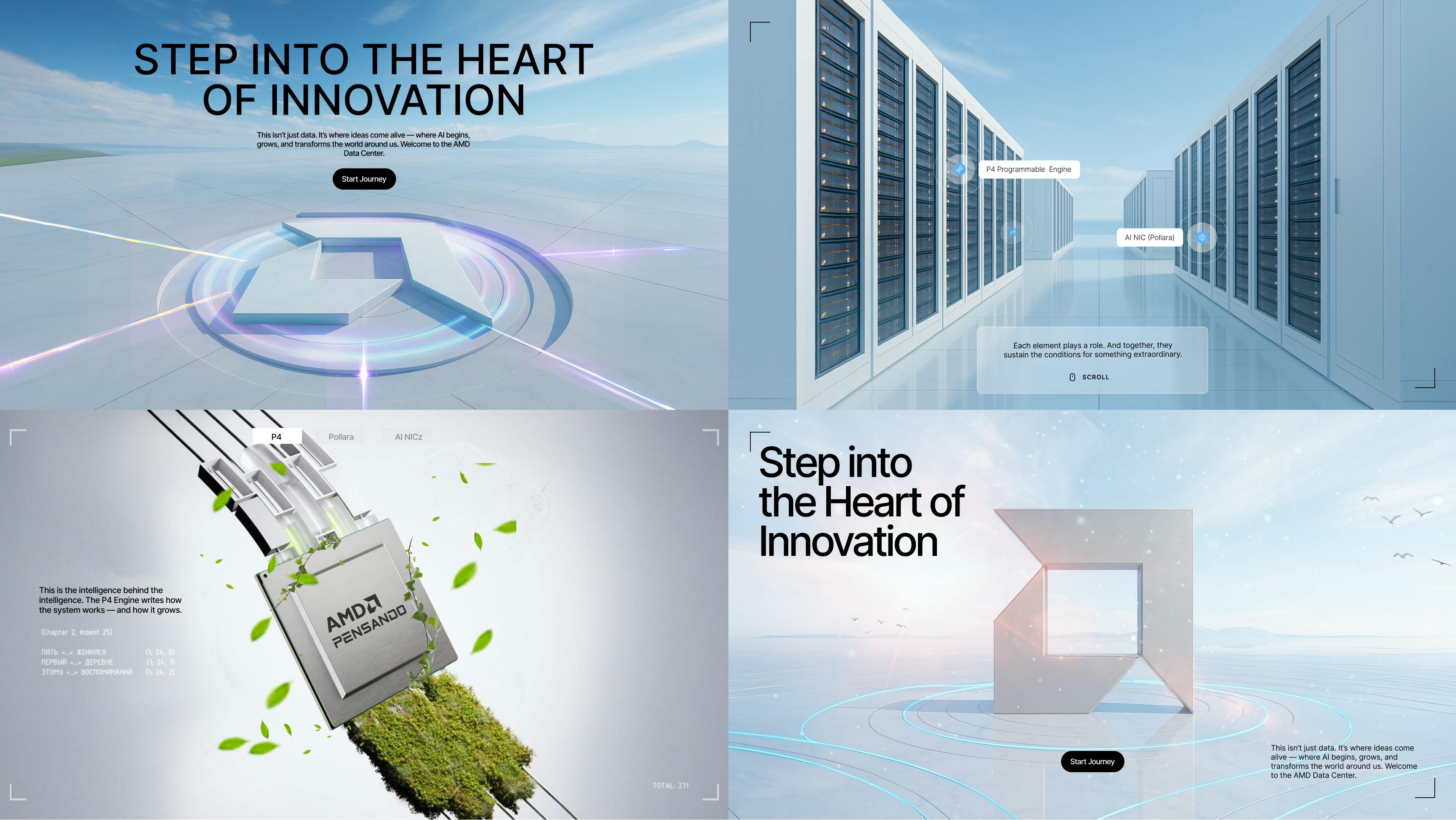 AMD AI Factory "Ecosystem" concept visualization showing interconnected components within living intelligent system emphasizing balance and collaboration
Through iteration and alignment with AMD’s long-term vision, the ecosystem approach emerged as the stronger foundation. It allowed the experience to communicate not just how data moves, but how intelligence is built through systems that adapt, respond, and evolve together.
The ecosystem ultimately became the conceptual backbone of the experience.
 AMD AI Factory refined ecosystem concept iteration establishing interconnected technology relationships as narrative backbone for experience
Spatial logic, interaction, and first-person storytelling
Once the ecosystem concept was established, the next challenge was translating it into a spatial experience users could intuitively understand.
In enterprise immersive design, spatial logic matters as much as visual design. Users need to understand where they are, what they are seeing, and how elements relate even in abstract environments. Architecture, layout, and navigation became narrative tools, shaping how information unfolds over time.
Interaction was treated as a core storytelling device rather than an enhancement layer. Instead of presenting information passively, the experience encouraged exploration through subtle interactive moments, small gamified elements, and hidden Easter eggs. This allowed complex information to be absorbed gradually, through discovery rather than exposition.
The first-person journey format was inspired by earlier narrative experiments such as Noomo ValenTime, where progression is driven by emotion, movement, and interaction rather than scrolling or reading:
https://noomoagency.com/work/noomo-valentime
Designing for complexity without losing clarity
Enterprise audiences expect both sophistication and clarity, neither can be compromised.
From the earliest conversations, deep technical immersion was essential. We studied AMD’s documentation and product materials to understand how each technology functioned and how it needed to be presented without overwhelming viewers.
This understanding shaped the architectural language:
- blue light lines representing data flow
- clean, symmetrical spaces evoking premium server rooms
- a refined, high-end atmosphere rather than visual “techno-chaos”.
The hardest part? Striking the right balance between a high-tech atmosphere and a cinematic aesthetic while keeping the product messaging crystal clear. To maintain engagement, subtle gamified elements and hidden Easter eggs encouraged exploration instead of passive observation.
Attention to detail anchored everything: grids, gradients, typography, micro-interactions, macro-interactions, and UI components that blended seamlessly with the 3D environment instead of feeling like a separate layer.
Balancing cinematic expression with enterprise clarity and trust
One of the most delicate challenges in enterprise immersive design is balancing emotional impact with clarity and trust.
Early visual explorations leaned toward brighter palettes and expressive motion, reinforcing the idea of a living system. Through testing and close collaboration with the AMD team, it became clear that while motion could remain organic, the visual tone needed to feel unmistakably AMD.
The experience transitioned to a darker, more controlled aesthetic, not for stylistic reasons, but to align precisely with AMD’s brand language and the physical booth environment. This ensured product messaging, UI elements, and system diagrams remained legible, while preserving a cinematic, premium atmosphere.
Engineering performance, scale, and visual fidelity in enterprise 3D experiences
At enterprise scale, performance is not a technical afterthought. It is a core part of the experience and a direct signal of credibility. Visually rich environments must remain fluid, stable, and responsive, especially when deployed across large physical installations and digital touchpoints.
To achieve this balance, the 3D environment was developed through a hybrid production workflow that combined kitbashing with fully custom-built assets. While kitbashing allowed for speed and structural consistency, every critical element was refined or rebuilt to meet AMD’s visual and technical standards. All server models were created in-house using AMD’s reference materials, ensuring architectural accuracy and brand alignment from the ground up.
A two-tier LOD strategy was implemented across the environment:
- Hero server models were designed for close-up interaction, camera fly-throughs, and animation-heavy moments. These assets carried the highest level of detail, material fidelity, and lighting response.
- Optimized background servers relied on details baked into custom texture maps, preserving depth and realism while keeping geometry lightweight and efficient.
This approach ensured high fidelity where it mattered most, while allowing the overall environment to remain scalable and performant.
Performance across the large environment was further optimized through extensive use of GPU instancing. Rather than duplicating geometry, procedurally generated instance data created in Houdini and exported as custom JSON defined transforms, rotations, and subtle variations across thousands of elements. This allowed large server arrays to be rendered efficiently without visual repetition or loss of art direction.
After testing more than a dozen variations, the final solution struck a deliberate balance: technically accurate, visually legible, and cinematic without becoming decorative. The result was an environment that felt complex and intelligent, yet easy to navigate and understand, even at scale.
From the beginning, performance constraints were treated as design constraints, not limitations. By integrating optimization strategies directly into the creative process, the experience maintained both visual richness and enterprise-grade stability.
For the final island, procedural techniques played a major role. Houdini’s Sci-Fi Panels SOP helped generate modular surface structures, while circuit-like pathways were shaped using iterative experiments with shortest-path algorithms, noise patterns, and masking. After testing more than a dozen variations, we arrived at a look that balanced technical accuracy with clear, readable visuals.
Accuracy, validation, and long-term thinking at enterprise scale
Accuracy was treated as a design requirement, not a constraint. Multiple server rack variations were developed to reflect real architectural differences and validated by AMD’s engineering team. Product visuals were carefully crafted to simplify complex information without losing depth.
Every element passed through AMD’s brand, legal, development, and product teams, ensuring the experience was not only compelling, but trustworthy.
The AI Factory was also designed as a system that could evolve. After launch, newly released AMD products were integrated seamlessly into the experience. Because the narrative structure, spatial logic, and technical foundation were already in place, the experience could grow without losing coherence.
For enterprise brands, immersive experiences must be adaptable, scalable, and reusable, not one-off moments.
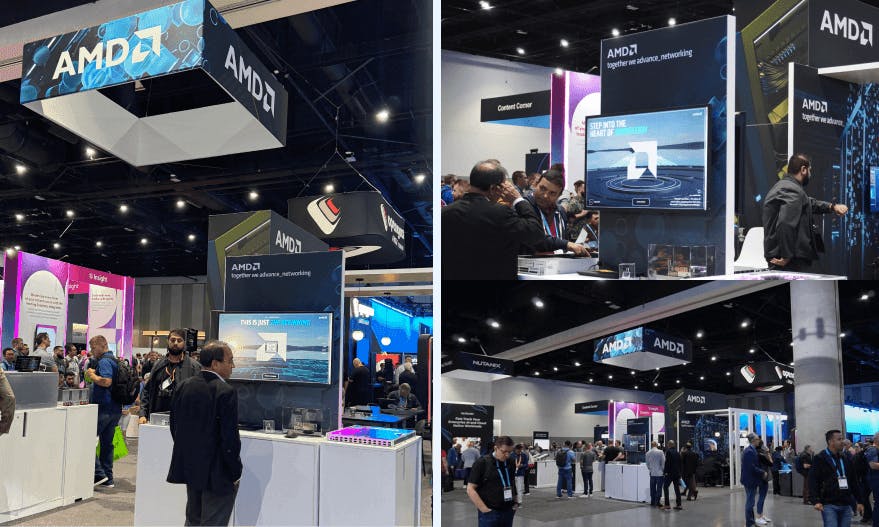 AMD AI Factory immersive event experience deployment at Cisco Live showing ecosystem environment with blue light data flow, premium server architecture, and cinematic aesthetics
Closing perspective on immersive event experience design
Immersive event experience design for enterprise brands is not about spectacle. It’s about translating complexity into clarity, systems into stories, and innovation into experiences people can intuitively explore and understand.
When narrative thinking, interaction design, and technical execution align, immersive experiences become not only events but also systems that scale, adapt, and endure.
Want to see the full execution?
This article focuses on the principles and process behind enterprise immersive event experience design. For the full visual breakdown, scope, and outcomes, explore the case study:
AMD AI Factory — Digital Event Experience
Frequently Asked Questions
What is immersive event experience design?
Immersive event experience design is the discipline of translating a complex product or system into an interactive environment people can intuitively explore at a live event. It spans spatial design, narrative structure, real-time 3D, interaction logic, and performance optimization working as one system. For enterprise brands like AMD, it means communicating deep technical complexity while staying clear, engaging, and emotionally resonant at the same time.
How do enterprise brands explain complex technology at events?
Start with the narrative system, not the visuals. For AMD's AI Factory, Noomo reframed a data center as a living ecosystem — a network driven by purpose and connection — then let users absorb complexity gradually through exploration, gamified moments, and hidden details rather than exposition. Visual language did the rest: blue light lines for data flow, clean symmetrical spaces, and UI that blends into the 3D environment.
How do you keep real-time 3D performance at enterprise scale?
Treat performance constraints as design constraints from day one. On AMD's AI Factory, Noomo used a two-tier level-of-detail strategy. It started with hero server models for close-up interaction, texture-baked background models for depth plus GPU instancing driven by procedural Houdini data to render thousands of elements without duplicated geometry. The result stays fluid and stable across large physical installations, which is itself a credibility signal for an enterprise brand.
Should an event experience be a one-off or a platform?
For enterprise brands, always a platform. AMD's AI Factory was built so newly released products could be integrated after launch without breaking the experience, because the narrative structure, spatial logic, and technical foundation were designed to scale. A one-off booth is a cost; an adaptable experience system keeps earning across trade shows, sales conversations, and digital touchpoints for years.
Related reading and projects
- Digital storytelling framework.
- Storytelling without words.
- AI-powered booth experience.
- Noomo Labs (interactive 3D).
- Vibrant Wellness - an immersive experience featured with an interactive 3D body system.
- Digital activation experience for Coinbase and LA Clippers - Bringing the energy of game night into fans’ hands.
- Golden State Warriors and Coinbase fun collectible. - An engaging 3D microsite that made the NFT minting process both intuitive and accessible for Golden State Warriors fans.
- AI-powered booth at MWC - brand activation experience for AI.IO | INTEL.
- Video Storytelling: Bringing Brand Narratives to Life Through 3D Animation
FAQ