



There is a particular kind of brief that sounds simple on the surface and reveals its full weight only once you're inside it. Vibrant Wellness came to Noomo with one of those.
The task was to create a digital experience centered on the human body. Its systems, its signals, its failures and corrections. The goal was to show what Vibrant lab tests actually do, in a way that felt immersive and high-end. Something that doctors, practitioners, and health-conscious visitors at a live event would stop in front of and actually want to explore.
What followed was one of the most compressed, technically demanding, and creatively rewarding sprints in our studio's history.
The Real Scope: Science First, Design Second
Most digital experiences start with aesthetics. A mood board, a color direction, a reference reel. This one had to start with biology.
Vibrant Wellness offers a comprehensive suite of lab tests spanning gut health, hormones, cardiovascular function, oxidative stress, toxin load, and neural health. Each test maps to specific organ systems and produces a set of biomarkers. These are measurable indicators that something inside the body is shifting out of balance. To design an experience that honestly represented this, we needed to understand what those biomarkers actually mean. Not just how to label them.
That meant sitting with the Vibrant science team and going deep. Which organs are involved in each panel? What does an elevated result indicate physiologically? What is the clinical cascade that follows from a single imbalance? We needed to understand the tests the way a practitioner understands them. Well enough that when we made a creative decision about how to represent a process visually, we were translating rather than inventing.
This phase wasn't a luxury. It was the foundation everything else was built on.
UX Architecture in Week One
Here's the reality of building a complex real-time 3D experience: the interaction model is structural, not decorative. You cannot design the visual language first and then figure out how users move through it. The navigation logic, the layered content hierarchy, the transitions between states all have to be defined before a single 3D asset is modeled. Every downstream decision depends on it.
With a timeline measured in weeks rather than months, we locked the full UX and UI flow in the first week. Not a rough sketch. The full architecture. The entry point through the stylized 3D human body. The navigation into six distinct body systems: gut, hormone, cardio, oxidative stress, toxin, and neural. The interactive hotspots within each system. The layered content structure that moves a user from discovery to interaction to genuine scientific insight.
This required making decisions on incomplete information and trusting the logic. It also required alignment between design, 3D, and development from day one. No handoff moments, no sequential phases. Everything ran in parallel because it had to.
Translating Biology Into Motion: The Hardest Creative Problem
Once the architecture was set, we faced the most demanding challenge of the entire project: turning complex biological processes into animations that are accurate, comprehensible, and visually compelling for an audience that includes practicing physicians.
The gap between what happens inside the body at a molecular level and what a person can intuitively understand from a 30-second animation is enormous. Bridging it without distorting the science required a translation workflow we developed specifically for this project.
We started with storyboards. Not motion references or style frames, but scientific storyboards. Each key biological process was written out step by step with the Vibrant science team, identifying the moments that matter: the tipping point, the feedback loop, the cascade. Those storyboards became animation briefs. Those briefs became production.
A Concrete Example: β-Glucuronidase and the Estrogen Loop
One of the sequences we were most invested in getting right involved the relationship between gut bacteria and hormone regulation. Specifically, the mechanism by which certain bacterial enzymes disrupt how the body processes estrogen.
Under normal conditions, the liver conjugates estrogens. It chemically modifies them so they can be safely excreted through bile and eliminated through the gut. The process is designed to keep estrogen levels balanced. But specific strains of gut bacteria produce an enzyme called β-glucuronidase, which cleaves that conjugate bond. Once deconjugated, the estrogens are no longer bound for excretion. They become free to be reabsorbed through the intestinal wall and recirculated into the bloodstream.
The result is an estrogen burden the body was actively trying to eliminate. Over time, this recirculation creates a systemic excess. It drives hormone imbalance, disrupts menstrual cycles, affects mood and metabolism, and increases susceptibility to estrogen-dependent conditions. The origin isn't in the ovaries or the adrenal glands. It's in the gut. It's a bacterial enzyme. And it's measurable on a lab panel.
Animating this sequence meant building a 3D intestinal environment, representing bacterial activity at a scale that reads visually, showing the enzymatic cleavage of the conjugate bond, and tracking the movement of deconjugated estrogen across the intestinal wall. The whole sequence had to feel continuous, like something happening inside a living body rather than a diagram being explained.
Every major process across every body system went through a version of this workflow. The gut, hormones, cardiovascular markers, neural signals, oxidative stress pathways, toxin accumulation. Each one required understanding the science before storyboarding it, and storyboarding it before animating it.
The 3D and Visual Language: Glass, Light, and Biological Precision
While the science translation work was happening, 3D production was running in parallel. The visual brief was set at the top of the range.
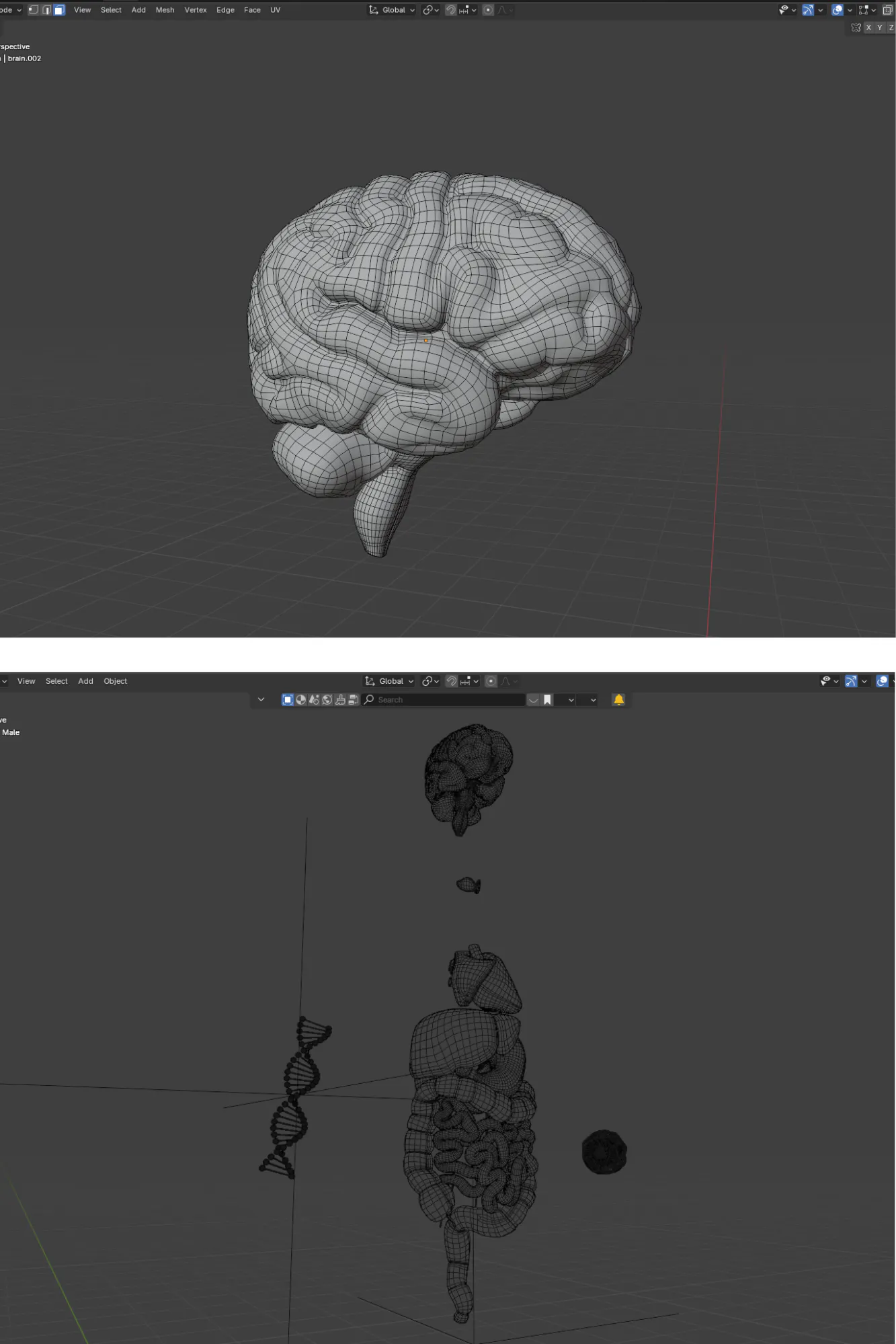
The central visual signature of the experience is a high-end glass shader applied to the 3D human body and its organ systems. Transparent, refractive forms that respond to light and create a sense of depth and materiality. The effect needed to be physically plausible, render in real time without performance issues, and integrate seamlessly with both the animated 3D body systems and the 2D motion graphics used to communicate processes that 3D alone couldn't convey.
The combination of real-time 3D with 2D animated overlays was a deliberate creative decision. Some biological processes are better represented through graphic, diagrammatic animation than through 3D space. Enzymatic reactions, molecular transport, biomarker thresholds. The experience moves fluidly between these modes, using each one where it serves the science and the user best.
The result is a visual language that sits at the intersection of medical precision and luxury wellness design. Credible to a practitioner, inviting to a layperson, and visually distinctive in a live event setting.
Designing for the Event Context
The Vibrant Wellness Summit 2025 was the first deployment. That context shaped several technical and design decisions that wouldn't apply in a standard web experience.
Large event screens demand compositions that read clearly from a distance and reward closer inspection. Input methods vary. Sometimes touch, sometimes mouse navigation. The interaction model has to work smoothly across both without requiring different cognitive modes from the user. The experience also needed to function as an ambient installation as well as an actively guided exploration, holding interest even when no one was directly interacting with it.
The three-layer architecture we locked in week one proved exactly right for this context. It moves from body overview to system navigation to test-level depth. Visitors could engage at whatever depth they had time and interest for. A 30-second visual impression of the body systems, or a detailed walkthrough of how a specific biomarker like β-glucuronidase connects to hormone health.
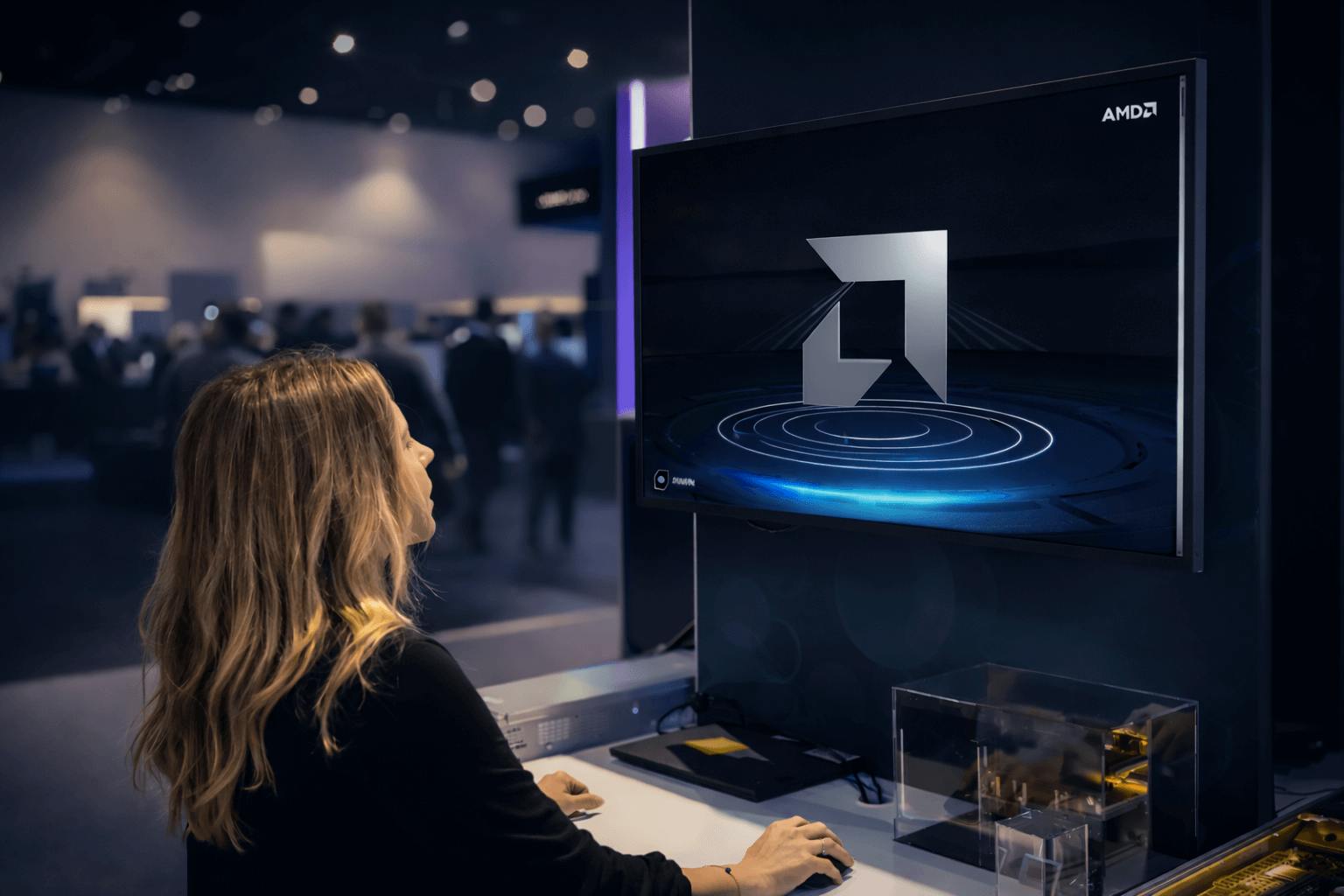
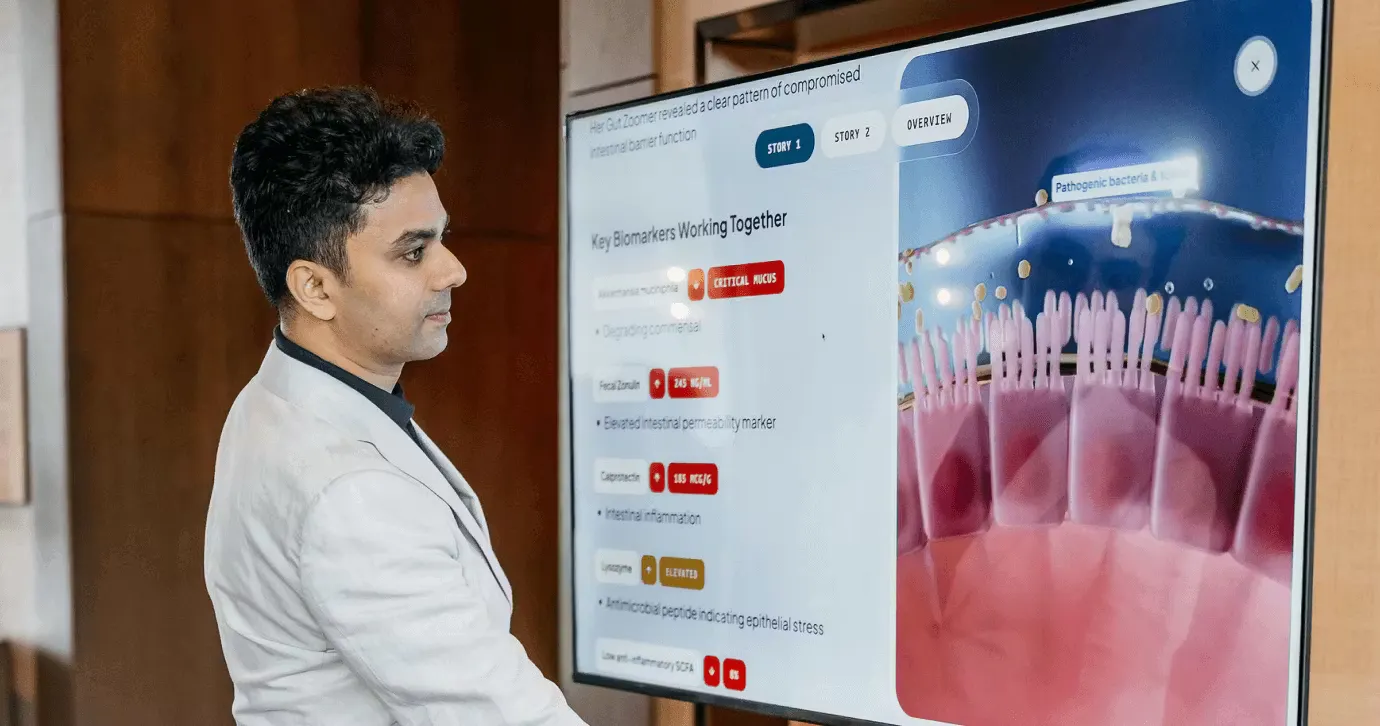 Visitors at Vibrant Wellness event are engaging with an immersive experience created by Noomo Agency
What This Project Taught Us
A few things became clear through this process that go beyond this specific project.
Subject matter expertise is not optional in science visualization. The creative decisions that made this experience work could only be made correctly by people who understood the science. Which biological moments to animate, how to represent a cascade, what visual metaphor maps to what enzymatic process. Fast-tracking that understanding was possible. Skipping it was not.
The UX architecture is the most load-bearing decision in complex 3D experiences. Getting it wrong late is catastrophically expensive. Getting it right early is a creative multiplier for everything that follows.
Accuracy and accessibility are not in tension. They require each other. The animations that worked best were the ones most faithful to the biology, because the biology has its own logic and drama. The β-glucuronidase sequence is compelling because what actually happens is remarkable. The job of design is to surface that reality, not simplify away from it.
Parallel production requires unusual trust. When design, 3D, and development run at the same time, decisions made in one track affect all the others. That only works when everyone involved understands the full project, not just their piece of it.
What Comes Next
What started as an interactive experience for an exclusive event is now an immersive website anyone can explore. It’s a new way to understand Vibrant Wellness’ core expertise in lab testing and wellness diagnostics. Instead of brochures or static charts, you can explore an interactive 3D body system.
You may try it yourself here.
Another exciting thing is that the framework built for the Summit is an expandable platform. New body systems, new test modules, new case studies and storylines can be added as Vibrant's product ecosystem evolves. What launched in 2025 is the foundation of something that will continue to develop as a long-term educational and engagement tool.
For us, it represents a body of work we're genuinely proud of. Not just because of what it looks like, but because of what it accurately represents. Complex science, made navigable. The human body, made legible. Lab data, made human.
Frequently Asked Questions
What is an immersive event experience?
An immersive event experience is an interactive digital installation that invites event visitors to explore a brand's story instead of watching a presentation. For the Vibrant Wellness Summit, Noomo designed a stylized 3D human body that attendees navigated through six body systems, discovering how lab tests and biomarkers actually work. The best installations work on large screens, support both touch and mouse input, and hold attention even as ambient visuals.
How do you make complex science accurate in an interactive experience?
For Vibrant Wellness, Noomo worked directly with the client's team to understand each biomarker and biological process. Then was writing storyboards which included step-by-step breakdowns of mechanisms like the β-glucuronidase estrogen loop before any animation began. Every creative decision translated real physiology rather than inventing visuals.
How long does it take to build an immersive 3D experience?
A complex real-time 3D experience typically takes a few months, but it can be compressed to weeks when design, 3D, and development run fully in parallel. The key is locking the complete UX architecture meaning the navigation logic and content hierarchy are structural, so every downstream decision depends on them. The Vibrant Wellness experience was built this way for a fixed summit date.
Can an event installation be reused after the event?
Yes, and it should be. The Vibrant Wellness experience launched as a summit installation and now lives as a public immersive website at vibrant.noomoagency.com, built as an expandable platform where new body systems and test modules can be added over time. Designing the architecture for reuse from day one turns a one-day event cost into a long-term educational and sales tool.
Noomo is a creative studio based in Los Angeles, specializing in immersive digital experiences, 3D design, and interactive storytelling for brands with complex stories to tell. See the Vibrant Wellness experience live at vibrant.noomoagency.com.
Related projects
- AI-powered booth experience.
- Noomo Labs (interactive 3D).
- Digital activation experience for Coinbase and LA Clippers - Bringing the energy of game night into fans’ hands.
- Golden State Warriors and Coinbase fun collectible. - An engaging 3D microsite that made the NFT minting process both intuitive and accessible for Golden State Warriors fans.
- AI-powered booth at MWC - brand activation experience for AI.IO | INTEL.
FAQ